

Traditional marketing broadcasts one message to many through TV, radio, print, outdoor, and direct mail, so you optimize slowly and measure impact with proxies like codes, calls, and surveys. Modern marketing targets defined segments using email, search, social, and SMS, so you personalize offers, track clicks and conversions in near real time, and shift budgets based on KPIs like ROAS, CAC, and retention. Keep going to see when each wins and how combining both boosts results.
Key Takeaways
- Traditional marketing broadcasts one message to broad audiences; modern marketing targets specific segments with personalized messages.
- Traditional relies on offline channels like TV, radio, print, and mail; modern uses digital channels like search, social, email, and SMS.
- Traditional measurement is slower and less precise; modern marketing tracks clicks, conversions, and ROAS in near real time.
- Traditional campaigns change slowly due to production and placement cycles; modern campaigns iterate quickly with A/B testing and daily budget shifts.
- Traditional builds mass awareness and credibility; modern focuses on measurable outcomes like revenue, retention, and lifecycle-driven engagement.
Traditional vs Modern Marketing: Core Differences

While both approaches aim to drive sales and build brand trust, traditional and modern marketing differ most in how you reach people, measure results, and optimize spend.
In traditional marketing, you typically broadcast one message to many and infer impact from lift in awareness or sales over time.
In modern marketing, you target defined segments, personalize creative, and track performance in near real time.
You’ll also manage budgets differently. Traditional spend often locks in upfront with limited flexibility, so you optimize slowly.
Modern spend shifts dynamically based on CAC, ROAS, and conversion rates, letting you reallocate fast.
With Brand storytelling, traditional relies on consistent narratives; modern lets you test story angles and iterate.
Customer engagement moves from passive exposure to two-way interaction, feedback loops, and measurable retention outcomes.
Traditional Marketing Channels and Best Use Cases
Traditional marketing earns its keep when you need broad, local reach and consistent repetition, especially in markets where digital targeting can’t fully capture attention. You’ll rely on high-frequency channels like radio, local TV, outdoor, and direct mail to drive awareness and foot traffic within a defined radius.
Print advertising works best when your audience reads community newspapers, magazines, or coupon circulars; you can measure impact through unique phone numbers, redemption codes, or store-visit lift by week.
Trade shows deliver concentrated B2B demand: you meet buyers face-to-face, qualify leads fast, and shorten sales cycles with live demos.
Use traditional channels when your goal is share-of-voice, neighborhood penetration, or credibility in regulated or older demographics. Plan consistent flights, track responses, and optimize.
Modern Marketing Channels: Targeting and Personalization
In modern marketing channels, you segment audiences with first- and third-party data so you can target by intent, behavior, and lifecycle stage.
You’ll deliver personalized omnichannel messaging across email, social, search, and SMS to lift relevance and conversion rates.
Then you’ll optimize in real time by tracking performance signals and reallocating budget, bids, and creative to hit your KPIs faster.
Data-Driven Audience Segmentation
Because customers leave measurable signals at every touchpoint—searches, clicks, purchases, and support interactions—you can segment audiences with data instead of guesswork. You start by defining outcomes like revenue, retention, or lead quality, then map behaviors that predict them.
With Data analytics, you unify first-party data from CRM, web events, and service logs, clean it, and build segments such as high-intent browsers, price-sensitive repeat buyers, or churn-risk accounts.
You test segment definitions against conversion rates, lifetime value, and cost per acquisition, then refine thresholds to improve lift.
Audience targeting becomes more precise because you prioritize spend on segments that respond, suppress low-propensity groups, and allocate budgets based on measured incremental impact, not assumptions.
Personalized Omnichannel Messaging
Once you’ve built reliable segments from behavioral and revenue signals, you can turn them into personalized omnichannel messaging that stays consistent across email, SMS, paid social, search, on-site experiences, and support touchpoints.
You tailor offers, creative, and cadence to each segment’s intent, not just demographics, so every impression advances a measurable goal.
With Customer personalization, you map messages to lifecycle stages—new, active, lapsing, high-LTV—and align value props to expected margin and conversion probability.
Omnichannel integration keeps your brand voice, pricing, and promises unified, reducing drop-off when customers switch devices or channels.
You also standardize UTM taxonomy, audience rules, and suppression lists, so you don’t overmessage, waste spend, or conflict with service communications.
Real-Time Campaign Optimization
While your omnichannel messages run, modern platforms let you optimize campaigns in real time by reading live performance signals—impressions, clicks, conversions, CAC, ROAS, and incrementality—and automatically shifting bids, budgets, placements, and creative toward what’s working. You don’t wait for weekly reports; you act on today’s intent.
Set guardrails for CPA and ROAS, then let algorithms reallocate spend to the highest-value audiences and suppress waste. Use Content automation to rotate variants, personalize offers, and refresh fatigue-prone ads before performance drops.
Tie every adjustment to a measurable outcome: more qualified leads, higher LTV, lower churn. When you integrate CDP and conversion APIs, you improve attribution and learn faster.
The result is stronger Customer engagement because users see relevant messages at the right moment, across channels.
Measuring Results: Traditional vs Modern Attribution

When you run traditional campaigns, you often estimate offline reach with surveys, circulation figures, or foot-traffic counts, then tie outcomes to broad trends.
With modern marketing, you can track touchpoints and apply data-driven attribution models that assign credit across channels based on real user behavior.
If you’re aiming to optimize ROI, you’ll need to compare these measurement approaches and choose the one that best matches your goals and audience journey.
Offline Reach Estimation
How do you prove an offline campaign actually reached the people who matter? You start with offline reach and audience estimation, not gut feel.
For TV or radio, you use rating points, station logs, and daypart fit to estimate unique households, frequency, and demographic mix.
For print and OOH, you combine circulation, placement audits, foot-traffic counts, and travel-path data to estimate impressions by location and time.
You validate with spot checks: vanity URL scans, coupon codes, call tracking, and in-store surveys that ask “Where did you hear about us?”
Then you compare results to your target profile and coverage goal—did you hit enough of your priority segments at the planned frequency, within budget?
That’s actionable proof without overclaiming precision.
Data-Driven Attribution Models
Reach estimates tell you who likely saw or heard your campaign; attribution tells you what those exposures actually did. In traditional marketing, you often rely on last-touch surveys, coupon codes, or lift studies that can’t connect every interaction to revenue. You’re forced to infer impact from averages and broad time windows, so budget decisions lag behind reality.
Modern data-driven attribution models tighten that loop. You connect impressions, clicks, CRM events, and conversions, then use Data modeling to control for seasonality, channel overlap, and delayed response.
Attribution algorithms assign fractional credit across touchpoints, revealing which sequences move specific audiences from awareness to purchase. You then optimize toward CAC, ROAS, or pipeline velocity, test creatives faster, and reallocate spend weekly instead of quarterly.
Cost, Speed, and Flexibility: Traditional vs Modern
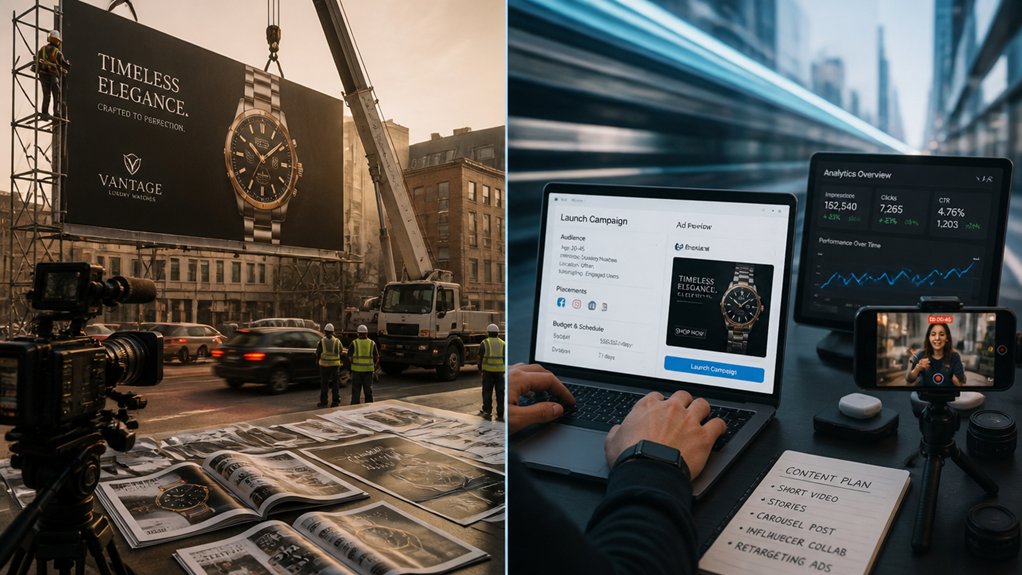
Although both approaches can drive awareness, they behave very differently on cost, speed, and flexibility.
Traditional marketing often requires higher upfront spend (printing, placements, production) and longer lead times, so your unit economics can be harder to control. You usually commit before you see results, which can limit cost effectiveness when response rates underperform.
Modern marketing lets you launch in hours, test multiple creatives, and shift budget daily based on KPI performance. You can cap CAC, optimize toward ROAS, and pause losers fast, improving speed-to-learning.
Flexibility also creates Innovation opportunities: you can personalize by segment, run A/B tests, and iterate messaging in real time. When your audience behavior changes, you can adapt without reprinting, reshooting, or renegotiating long contracts.
How to Combine Traditional and Modern (With Examples)
Speed and flexibility give modern marketing an edge, but you’ll get the strongest ROI when you pair it with traditional channels that add scale and trust. Start with one goal (leads, foot traffic, or retention), then set shared KPIs: QR scans, call tracking, coupon redemptions, and lift in branded search.
Use TV, radio, or direct mail to reach broad segments, then retarget responders with paid social and email sequences.
Example: a local gym mails a free-week pass with a QR code; you follow up with Instagram testimonials and an SMS offer to book a tour.
Example: a B2B SaaS runs trade-show booths for credibility, then uses LinkedIn ads and webinars to qualify demand.
Tie it together with creative storytelling and consistent brand storytelling across every touchpoint.
Frequently Asked Questions
What Skills Do Marketers Need to Transition From Traditional to Modern Marketing?
You’ll need skills in Content strategy and Data analytics to move confidently into modern marketing. You’ll set measurable goals, map audience segments, and build content that matches intent across channels.
You’ll track KPIs (CAC, LTV, conversion rate), run A/B tests, and optimize based on performance data.
You’ll get comfortable with marketing automation, CRM workflows, SEO, and paid media dashboards, so you can personalize campaigns and prove ROI fast.
How Do Privacy Laws Affect Modern Marketing Compared to Traditional Campaigns?
Privacy laws restrict how you collect, store, and activate customer data, so you can’t rely on broad third‑party tracking like many modern tactics once did. You must design consent-first journeys, document Data privacy controls, and prove lawful use to hit targeting and measurement goals.
Compared to traditional campaigns, you’ll shift budget toward first‑party data, contextual targeting, and privacy-safe analytics, which strengthens Consumer trust and reduces compliance risk.
Which Marketing Approach Works Best for Regulated Industries Like Healthcare or Finance?
You’ll get the best results with a compliance-first, omnichannel approach that blends vetted digital targeting with controlled offline touchpoints.
You prioritize Regulatory compliance by using approved claims, documented consent, and auditable workflows.
You address Ethical considerations through transparent disclosures, bias checks, and patient/customer-first messaging.
You track goals with CAC, lead quality, conversion, and complaint rates, then optimize by segment, channel, and lifecycle stage.
You’ll scale safely without risking fines.
How Can Small Businesses Modernize Marketing Without Large Tech Investments?
You can modernize your marketing by focusing on low-cost, high-impact habits. Did you know 71% of consumers expect personalized interactions? Use Content personalization with simple CRM tags, email segments, and tailored landing pages.
Boost Social media engagement by replying within an hour, running weekly polls, and reposting customer stories. Track two KPIs—lead cost and conversion rate—then A/B test headlines and offers monthly.
You’ll scale what works, fast.
What Common Mistakes Cause Modern Marketing Campaigns to Underperform?
You’ll see modern campaigns underperform when you guess your Target audience, track vanity metrics, and skip clear KPIs tied to revenue.
You also lose results when you spread budget across too many channels, ignore creative testing, and let slow landing pages kill conversions.
Weak Brand storytelling makes ads forgettable, while inconsistent messaging hurts trust.
Finally, you don’t retarget or nurture leads, so CAC rises and LTV stalls over time.
Conclusion
If you treat traditional and modern marketing like rivals, you’ll leave absurd amounts of revenue on the table. Traditional channels can blanket a city in awareness overnight, while modern tactics let you target one buyer, one click, one conversion at a time. Track reach, response rate, CAC, and LTV, then reallocate weekly—not yearly. When you combine TV, radio, or print with retargeting, email, and SEO, you’re not “marketing”; you’re building a growth machine.
About the Author