
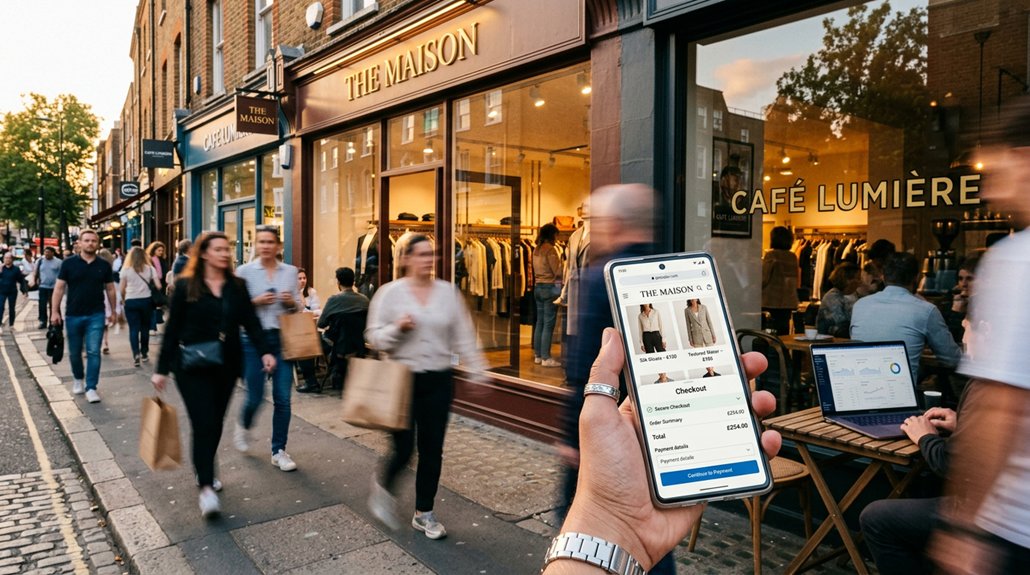
You don’t need a big ad budget to turn high-street recognition into online brand awareness. Start by auditing your digital footprint: Google Business Profile, local SEO rankings, branded search volume, review velocity, and social reach. Then align your online messaging and visual identity with what customers already trust offline, and set benchmarks you can track weekly. Once you see where attention drops off, you’ll know the next moves that create compounding visibility…
Key Takeaways
- Audit your current visibility using Google searches, Search Console, and social listening to find brand gaps and quick-win optimizations.
- Set measurable awareness goals like branded searches, reach, and sentiment, then track weekly progress against clear benchmarks.
- Translate your offline story into consistent online messaging using founder hooks, “why us” bullets, FAQs, and customer proof across channels.
- Standardize visuals with a style guide, locked templates, and an asset library to keep logos, colors, and layouts consistent everywhere.
- Optimize Google Business Profile and local SEO with correct categories, NAP consistency, fresh posts, and fast review responses to win “near me” searches.
Audit Your Current Brand Awareness Online

Where does your brand stand online right now? Start with a fast visibility scan: Google your brand name plus core keywords, then log rankings, People Also Ask mentions, and top 10 SERP competitors.
Pull Search Console and analytics data to flag pages driving impressions but low clicks; refine titles, meta descriptions, and schema to lift CTR.
Check share of voice across social and review platforms by tracking branded mentions, sentiment, and response time to quantify Brand perception.
Next, validate Audience targeting. Compare your follower demographics, referral sources, and on-site behavior against your ideal customer profile.
Audit paid and organic audiences for overlap, wasted reach, and high-intent segments.
Finally, review consistency: logos, messaging, NAP citations, and product descriptions across listings and marketplaces.
Set Clear Brand Awareness Goals and Benchmarks
Set brand awareness goals by defining exactly what you want to grow—branded search volume, social reach, or share of voice—and by when.
Choose key metrics you’ll track weekly, such as impressions, unique reach, direct traffic, branded CTR, and brand mention sentiment.
Set benchmark targets from your current audit and lock in numeric lift goals (e.g., +20% branded searches, +15% reach) so you can measure impact and optimize fast.
Define Awareness Objectives
How do you know your brand awareness strategy’s working if you haven’t defined the outcome upfront? Start by writing one primary objective tied to business value: increase unaided recall, shift brand perception, or enter a new category conversation. Anchor it to a specific target audience segment, not “everyone,” so your messaging and channels stay focused.
Next, set a time box and baseline: what’s true today, and what must change in 30, 60, or 90 days? Translate the objective into clear benchmarks like “become a top-three remembered brand in X niche” or “improve preference among first-time buyers.” Keep objectives few, measurable, and aligned with your positioning.
Document assumptions, approvals, and constraints so teams execute consistently. Review objectives quarterly and update them when markets, products, or competitors shift quickly.
Choose Key Metrics
Before you spend on reach and impressions, choose brand awareness metrics that directly map to your objective and give you a clean baseline. If you’re driving brand recognition, track aided and unaided recall from quick surveys, plus branded search volume and direct traffic in analytics.
If you’re expanding visibility, monitor unique reach, frequency, and share of voice across search and social. To validate message pull, measure audience engagement: view-through rate, average watch time, saves, comments, and repeat visitors.
For off-site credibility, use referral mentions, backlink growth, and PR pickups. Instrument everything with UTM tags, consistent naming, and channel-level dashboards. Segment by audience, geography, and device so you can see where awareness actually lifts.
Keep reporting weekly to spot anomalies fast.
Set Benchmark Targets
Apply audience segmentation so you can benchmark by cohort (new vs returning, local vs national, high-intent vs casual) and spot where awareness really grows.
Tie every target to brand positioning: track message recall, keyword associations, and sentiment for your core value props.
Review weekly, reset monthly, and document deltas with time-stamped dashboards for stakeholders.
Translate Your Offline Story Into Online Messaging
Three brand signals—your origin story, customer proof, and differentiator—should show up consistently in every online message, because consistency directly improves brand recognition and recall across channels.
Audit your current pages and ads: do those three signals appear in headlines, meta descriptions, and pinned posts? If not, rewrite.
Turn offline storytelling into scannable assets: a 20-word founder line, a 3-bullet “why us,” and one quantified result (e.g., “4.8★ from 1,200 locals”).
Use customer proof as data: review snippets, before/after stats, and FAQs built from top in-store questions.
For community engagement, highlight partnerships, local events, and UGC prompts, then track lift in branded searches, CTR, and returning visitors weekly to validate message-market fit.
Keep Your Visuals Consistent Everywhere
You’ll boost brand awareness online faster when you lock in a unified brand style guide and use it to standardize your logo, colors, and typography.
Keep cross-platform visual alignment across your website, social media, email, and ads so every touchpoint reinforces instant recognition.
Audit your creative weekly and fix off-brand assets immediately to protect consistency and lift recall.
Unified Brand Style Guide
Even if your content reaches the right audience, inconsistent visuals can dilute brand recall and weaken brand awareness online. A unified brand style guide fixes that by locking in Brand consistency across every asset you publish, from ads to landing pages to email headers.
Build your guide with measurable rules: logo spacing, color hex codes, typography hierarchy, button styles, photo filters, icon sets, and illustration tone. Define a Visual storytelling framework too—approved imagery themes, subject framing, and data-visual templates—so your narrative stays recognizable and fast to produce.
Add do/don’t examples, file links, and version control, then assign an owner and review cadence. Track impact with QA checklists and creative error rates; fewer revisions and higher recognition signals you’re tightening brand memory. Update it quarterly as campaigns shift fast.
Cross-Platform Visual Alignment
A brand style guide sets the rules; cross-platform visual alignment makes sure those rules show up the same way on every channel your audience touches. When your website, social posts, email templates, ads, and app screens match in layout, typography, imagery style, and UI patterns, you reduce cognitive load and speed recall—fueling Visual consistency and Brand recognition.
Audit your top five touchpoints and map reusable components: headline sizes, button styles, icon sets, photo treatments, and spacing. Build a shared asset library and lock templates in your design tool so teams don’t freestyle.
Track impact with scroll depth, CTR, and time-to-first-action across channels; misaligned visuals often correlate with higher bounce and lower conversion. Set monthly QA checks and refresh assets when platforms change.
Consistent Logo And Colors
Logo and color consistency does more than “look nice”—it strengthens brand recognition across every impression, so people spot you faster in crowded feeds, inboxes, and search results. Treat your logo as a fixed asset: lock spacing, clear space, minimum size, and acceptable backgrounds. Enforce Logo consistency by using one master file and publishing a simple usage guide for partners, affiliates, and your own team.
Build color harmony with a tight palette (primary, secondary, neutral) and document HEX, RGB, CMYK, and accessibility contrast ratios. Then audit every touchpoint—website header, favicon, social avatars, email templates, ads, packaging photos, and thumbnails—for drift.
Set QA checkpoints in your workflow and automate templates in Canva/Figma. Consistency lifts recall and reduces wasted impressions.
Get Discovered With Google Business Profile and Local SEO
When people nearby search “best [your service] near me,” Google Business Profile and local SEO decide whether you show up in the Map Pack or get buried below competitors. Claim and verify your profile, then perfect your NAP (name, address, phone) so citations match everywhere—Google rewards consistency.
Choose primary and secondary categories that mirror high-intent keywords, and add services with location modifiers (e.g., “emergency plumber in Brixton”). Post weekly updates, upload geo-tagged photos, and answer Q&A to increase engagement signals.
Ask for reviews after each job, reply with keywords, and target a 4.5+ rating—Map Pack CTR rises sharply with stronger ratings. Optimize for Voice search with natural FAQs, and guarantee Mobile optimization: fast pages, click-to-call, and driving directions.
Build Brand Awareness With Repeatable Social Series
Google Business Profile gets you found at the moment of intent; repeatable social series keeps you top-of-mind before the search happens.
Build a weekly format your audience can recognize in 2 seconds: “Tip Tuesday,” “Behind-the-Counter Friday,” or “Myth vs Fact” reels. Lock a template (hook, 3 bullets, CTA) and batch-produce 4–6 posts to stay consistent.
Track reach, saves, shares, and 3-second view rate; double down on topics that lift saves by 20%+ week over week.
Use Interactive campaigns like polls, quizzes, and UGC challenges to increase comments and algorithmic distribution.
Add influencer collaborations with local creators: co-host a live demo, run a takeover, and repurpose clips into shorts.
Keep creative consistent; test one variable at a time.
Earn Repeat Attention With SEO Content and Email

Because social reach can swing week to week, you need SEO content and email to earn repeat attention on channels you control. Build a Content strategy around high-intent keywords: map 10–20 queries to each product category, then publish one pillar page plus 4–6 supporting articles that answer “price,” “best,” and “near me” modifiers.
Optimize titles, H1s, internal links, and schema so you lift impressions and CTR in Search Console.
Capture emails with category-specific lead magnets and onsite prompts, then segment by interest and recency. Send a weekly digest that re-promotes your best pages and a 3-email welcome flow that drives first clicks.
Track Customer engagement with open rate, clicks, and returning sessions, and iterate topics monthly.
Use Reviews, UGC, and Social Proof to Be Chosen
SEO and email earn you repeat visits, but reviews and UGC often decide who gets the click and the sale. You’ll win more first-time buyers when your ratings, photos, and proof show up where intent is highest: Google Business Profile, product pages, and key category pages.
Ask for reviews at the moment of delight (delivery, service completion) and make it frictionless with a one-tap link. Feature customer testimonials above the fold, add schema markup for star snippets, and pin best quotes in ads and landing pages.
Curate UGC into shoppable galleries, then A/B test placements against conversion rate and time on page. Build trust fast by responding to every review within 24 hours, addressing specifics, and closing the loop.
Use influencer collaborations to seed authentic demos, not scripts.
Co-Market With Local Partners: and Double Down on What Works
When you co-market with local partners—gyms, salons, cafés, realtors, clinics, or nearby retailers—you tap into warm, location-based audiences and lower your customer acquisition cost.
Build Collaborative campaigns around shared offers: QR-code landing pages, joint email drops, and co-branded Reels that tag both locations and target “near me” keywords.
Add Local sponsorships for events, school teams, or charity runs, then retarget attendees with geo-fenced ads and a limited-time bundle.
Track everything: UTM links, call tracking, promo codes, and Google Business Profile insights.
Double down on what works by reallocating budget to partners driving the highest conversion rate and lowest CPA, and pause low-performing channels fast.
Repeat monthly, test one variable at a time, and scale winners.
Frequently Asked Questions
How Much Should I Budget Monthly to Grow Online Brand Awareness?
You should budget $1,500–$5,000 monthly to grow online brand awareness, then scale to 8–12% of revenue. Fund Content Strategy, paid reach, and Social Engagement; track CPM, reach, frequency, and branded search lift weekly.
How Long Does It Take to See Measurable Brand Awareness Results?
You’ll typically see measurable brand awareness results in 6–12 weeks, with stronger gains by 3–6 months. Track brand recognition via branded search lift and recall surveys, and customer engagement via CTR, shares, repeat visits.
Which Tools Best Track Brand Awareness Across Channels in One Dashboard?
You’ll track cross-channel brand awareness best with Sprout Social, Hootsuite, or Brandwatch in one dashboard; pair GA4 with Looker Studio. Add Content analysis and influencer collaborations tracking, plus UTM tags and survey lifts.
Should I Hire an Agency or Build an In-House Marketing Team?
You should hire an agency first, then build in-house—like lighting a rocket before forging the engine. You’ll move faster with influencer partnerships, content syndication, and KPI dashboards; then hire specialists once CAC stabilizes and ROI proves repeatable.
How Do I Protect My Brand From Impersonation and Fake Social Accounts?
You protect your brand by filing Trademark protection, monitoring mentions daily, and reporting fakes fast. You should pursue Social media verification, lock consistent handles, enable 2FA, publish official links, and document evidence for takedowns quickly.
Conclusion
You’ve got the offline reputation—now turn it into measurable online brand awareness. Track your baseline (search impressions, branded queries, Google Business Profile views), then set weekly targets and test fast. Keep visuals and messaging consistent, post repeatable social series, and publish SEO content that matches local intent. Collect reviews and UGC to raise trust and click-through rates. Partner with nearby businesses to expand reach. Keep your eye on the ball, and double down on what converts.
About the Author