
Make email marketing more effective by picking one revenue-focused goal (revenue per recipient, trials, or qualified leads) with clear guardrails for deliverability and unsubscribes. Segment subscribers by intent, lifecycle stage, and engagement, then personalize subject lines and offers to match their next best step. Use mobile-first layouts with one clear CTA above the fold. Automate welcome, nurture, and post-purchase flows within 24 hours. Track CTR-to-conversion lift and A/B test cadence, content, and CTAs to keep improving over time.
Key Takeaways
- Set clear success metrics and guardrails, then track conversions and revenue per send—not opens—using consistent attribution windows.
- Segment subscribers by lifecycle stage and behavior, and personalize content with minimal data to keep targeting relevant and explainable.
- Write benefit-led subject lines and concise copy, leading with the payoff and using one clear CTA supported by specific proof points.
- Design mobile-first emails with one-column layouts, readable fonts, and thumb-friendly buttons, placing the primary CTA above the fold.
- Automate key workflows like welcome, abandonment, and post-purchase sequences, and adjust cadence by engagement while pruning inactive contacts.
Set Goals for Your Email Campaigns

Before you write a single subject line, define exactly what success looks like for your email campaign—because clear goals drive better targeting, stronger offers, and measurable results.
Pick one primary metric per send: revenue per recipient, qualified leads, trial starts, or retention. Set a numeric target and a deadline, then map it to controllable levers like send frequency, CTA placement, and landing-page conversion rate.
Establish guardrails too: minimum deliverability, unsubscribe ceiling, and complaint-rate limits. Build email list hygiene into the goal so you protect sender reputation and lift engagement; prune inactive contacts and suppress bounces.
Account for spam filtering by aiming for inbox placement, not just opens. Finally, define your measurement plan upfront: attribution window, baseline, and the single report you’ll act on.
Know Your Audience and Email Offer
You’ll convert more when you segment your list by measurable needs—behavior, lifecycle stage, and past purchases—instead of blasting one message to everyone.
Use what your data tells you to match each segment with an offer that fits their interests and urgency, then tailor the subject line and CTA to that intent.
When the right audience gets the right offer, you’ll lift opens, clicks, and revenue per send.
Segment By Audience Needs
Why send the same email to everyone when your subscribers sign up for different reasons? Segment by audience needs so you can speak to intent, not assumptions. Start with signup source, lead magnet, lifecycle stage, and engagement signals (opens, clicks, site visits).
Then tag subscribers by Audience preferences—topics they choose, cadence they tolerate, and devices they use—so every send feels relevant. Use content personalization to change subject lines, intros, and recommended resources based on those tags, and you’ll lift conversions without increasing volume.
Track performance by segment, not by list: monitor click-to-open rate, reply rate, and unsubscribe rate to spot mismatches fast. Refresh segments monthly, and suppress inactive users to protect your deliverability and keep your metrics honest.
Match Offers To Interests
Even if your copy lands perfectly, conversions stall when the offer doesn’t match the subscriber’s current goal. Use behavior data—clicks, pages viewed, trial status, purchase recency—to predict intent, then map each segment to one next-best offer.
If someone browsed pricing, send a demo or comparison guide; if they read how-to content, send templates or a starter kit.
Drive relevance from the top: apply Subject line creativity that mirrors the exact interest (“Finish your setup in 10 minutes”) and test it against a benefit-led control.
In-body, follow Email design tips that reduce friction: one primary CTA, scannable bullets, and personalized modules (recommended products, content, or upgrade paths).
Track lift via CTR-to-conversion rate, not opens.
Build Your List (Opt-Ins, Lead Magnets, Forms)
To grow revenue from email, you need a list built on permission—and that starts with an irresistible lead magnet that matches your audience’s top intent.
You’ll lift opt-in rates when your forms make the value obvious, ask only for what you need, and remove friction across devices.
Next, you’ll learn how to design lead magnets and high-converting opt-in forms that turn traffic into subscribers at scale.
Irresistible Lead Magnets
How quickly can you turn casual traffic into subscribers who’re ready to buy? Start with a lead magnet that solves one urgent problem in under 10 minutes.
Your best-performing offers usually trade “time saved” for an email: checklists, swipe files, calculators, templates, and short how-to playbooks.
Use Creative incentives tied to purchase intent—coupon ladders, product-match quizzes, or “before you buy” comparison guides—so subscribers enter already primed.
Add Visual hooks to boost perceived value: a cover mockup, preview pages, or a 20-second demo clip.
Keep the promise specific (“Cut onboarding time by 30%”) and validate with one metric, testimonial, or mini case study.
Then segment delivery by intent so follow-up emails hit harder, faster.
High-Converting Opt-In Forms
A strong lead magnet only earns subscribers if your opt-in form removes friction and makes the payoff obvious. Keep fields to name and email; every extra field can drop conversions. Put the benefit in the headline, add one proof point (downloads, ratings, or results), and use a single, action verb CTA.
Use Interactive pop ups strategically: trigger on exit intent, scroll depth, or time-on-page so you’re matching intent, not interrupting. A/B test the offer, button copy, and layout; small tweaks often lift opt-ins.
Optimize for mobile with large inputs, fast load times, and no tiny checkboxes. Add Social sharing on the thank-you page to turn new subscribers into referrers, and tag sources so you can scale what converts.
Choose an Email Platform: Automation, Templates, Reporting
Because your email tool directly shapes deliverability, speed, and revenue tracking, you should choose a platform that nails three essentials: automation, templates, and reporting.
Start with automation: pick an Email platform that triggers welcome and abandonment sequences, applies send-time optimization, and supports A/B testing so you can lift clicks without extra labor.
Next, templates: choose mobile-first, brandable layouts with drag-and-drop blocks and reusable sections, so you can ship faster and keep design consistent across promos and newsletters.
Finally, reporting: demand campaign analytics that tie opens and clicks to conversions, revenue, and unsubscribes, plus per-link and device breakdowns.
If it integrates with your store, CRM, and pixels, you’ll attribute sales accurately and scale what works.
Segment Subscribers for More Relevant Sends
When you segment subscribers, you turn generic blasts into targeted messages that typically lift opens, clicks, and revenue per send.
Use behavioral segmentation triggers—like page views, cart activity, and past purchases—to automate timely emails that match intent.
Then group people by lifecycle stage (new lead, active customer, lapsed buyer) so you can send the right offer and next step to move them toward conversion.
Behavioral Segmentation Triggers
If you want higher opens, clicks, and revenue without blasting your whole list, use behavioral segmentation triggers to send messages based on what each subscriber actually does.
Track site visits, product views, cart activity, email clicks, and purchase frequency, then map each action to a specific send.
When someone browses a category twice, trigger a tailored recommendation email within 1–3 hours; when they abandon cart, send a reminder plus social proof; when they click a feature link, deliver a short demo sequence.
Use Behavioral triggers to throttle frequency, so engaged readers get more and silent ones get fewer.
Test subject lines and timing by behavior cohort, and set KPIs per trigger.
These engagement tactics turn intent signals into conversions, with less fatigue.
Lifecycle Stage Grouping
How do you keep emails relevant as your list grows and subscribers change? Group subscribers by lifecycle stage—new lead, engaged prospect, first-time buyer, repeat customer, lapsed—and tailor your sends to what they’re most likely to do next.
Your data already signals stage: signup date, last open, site visits, purchase frequency, and support tickets. Use customer feedback to refine messaging: objections in surveys become onboarding answers; feature requests become upgrade angles.
Keep brand consistency by locking core voice, value props, and visual system across stages, while swapping offers, proof, and CTAs.
Aim for measurable lifts: higher activation rates for new leads, higher AOV for repeat buyers, and reduced churn from win-back sequences. Test stage-based cadences weekly.
Write Subject Lines People Actually Open
Although your email body does the selling, the subject line determines whether anyone sees it at all—most campaigns live or die on opens driven by relevance. Use lifecycle data to promise a clear payoff: “Your trial ends Friday—keep your setup” beats “Reminder.”
Apply subject line psychology by matching intent (problem, progress, proof) to the reader’s stage, then test it. Aim for 30–45 characters so mobile users see the value fast, and put the differentiator first.
Use emotional triggers sparingly: urgency, curiosity, and belonging outperform hype when they’re specific (“3 fixes for your checkout drop-off”).
Personalize with behavior, not just a first name. Run A/B tests on one variable, track open rate by segment, and roll winners into your swipe file.
Write Email Copy That Earns Clicks and Sales

When your subject line wins the open, your copy has one job: move the reader from interest to action with minimal friction.
Lead with the payoff in the first sentence, then back it with one proof point (a stat, testimonial, or result) that matches the segment’s intent.
Write like you’re answering “What’s in it for me?” and “What do I do next?”
Use short paragraphs, concrete benefits, and a single primary CTA that’s impossible to miss.
Reduce risk with specifics: price, timeline, guarantee, or next step.
Keep Email etiquette tight—clear sender identity, honest claims, and respectful frequency.
Stay compliant with spam policies by avoiding deceptive phrasing, excessive hype, and link stuffing.
Test one variable per send, then scale what lifts clicks and revenue.
Design Emails That Read Well on Mobile
Because over 60% of emails get opened on phones, you need mobile-first design that lets readers scan, tap, and convert in seconds.
Keep your subject preview supported with a clear top headline.
Then build visual hierarchy with short paragraphs, bold subheads, and one primary CTA above the fold.
Use 16px+ body text, 44px-tall buttons, and generous padding so thumbs don’t mis-tap.
Limit columns to one and keep images lightweight to protect load time; every extra second can cut clicks.
Choose color schemes with high contrast (WCAG-friendly) and test dark mode so links and buttons stay visible.
Put key benefits in the first screen, avoid tiny footer links, and run A/B tests on CTA placement and button color.
Personalize Emails Without Crossing the Line
Even if you’ve got rich customer data, personalization only works if it feels helpful—not invasive—since overly “creepy” targeting can spike unsubscribes and spam complaints fast. Use “minimum effective data”: first name, broad interest, and recent category views, not exact location or “we saw you” language.
Segment by intent signals (clicked, browsed, purchased) and keep targeting explainable in one sentence. Test subject lines that reference value, not surveillance, and monitor complaint rate, unsubscribe rate, and revenue per send.
Add Emotional storytelling that mirrors your reader’s job-to-be-done—problem, proof, payoff—without exposing private specifics. Reinforce trust with consistent Visual branding, clear preference controls, and a simple “why you’re getting this” footer.
You’ll lift clicks while keeping consent—and deliverability—healthy.
Set Up Automations: Welcome, Nurture, Post-Purchase
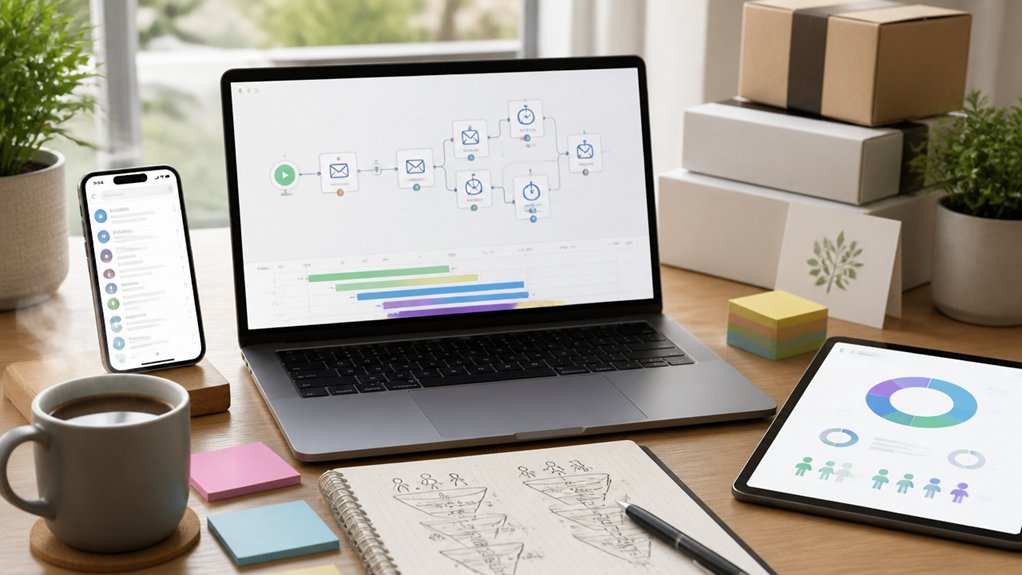
Although most campaigns live or die on timing, you’ll get more consistent revenue by letting automations handle your highest-intent moments. Build Automated workflows that fire instantly: a welcome series that confirms value, sets expectations, and drives the first click within 24 hours, when sign-up intent peaks.
Follow with a nurture path that adapts to behavior—browsed, clicked, or ignored—using Engagement triggers to swap content, offers, and proof points. Keep each step focused on one conversion action, and measure lift with holdouts or A/B splits.
After purchase, launch a post-purchase flow that reduces refunds, increases repeat orders, and collects reviews: onboarding tips, replenishment reminders based on typical usage, and cross-sells tied to what they bought. Optimize by revenue per recipient, not opens alone.
Pick a Sending Cadence Subscribers Won’t Hate
When you send too often, unsubscribes and spam complaints spike; when you send too little, your list forgets you and conversion rates slide. You need a cadence that matches attention spans and buying cycles, not your content calendar.
Start with one newsletter weekly, then validate with metrics: open rate stability, click-through lift, and revenue per send. If engagement drops for two consecutive sends, throttle back; if clicks and orders rise, test an extra touchpoint.
Segment your cadence by intent. Warm leads can handle 2–3 emails a week; cold subscribers may prefer biweekly. Keep frequency predictable, but vary value: Creative storytelling for interest, and Visual branding for instant recognition.
Run A/B tests on send-day and spacing, and let subscriber actions set the pace.
Boost Deliverability: Authentication, Hygiene, Trust
A smart sending cadence only pays off if your emails actually land in the inbox, so protect deliverability with three levers: authentication, list hygiene, and sender trust.
Start with Email authentication: publish SPF and DKIM, then enforce DMARC to reduce spoofing and improve inbox placement signals.
Next, tighten list hygiene: suppress hard bounces, remove long-term inactives, and use confirmed opt-in to keep complaint rates low and engagement high.
Finally, build trust with consistent “From” names, clear unsubscribe links, and content that matches signup promises.
Ramp volume gradually after new domains or IPs, and segment by engagement so your best readers lead the reputation curve.
When you safeguard deliverability, you protect revenue, because every blocked message is a missed conversion opportunity.
Measure and Test: Revenue per Email, A/B Experiments
Run disciplined A/B experiments: test one variable, set a minimum detectable lift, and stop when you hit statistical confidence.
Prioritize subject lines, offer framing, and CTA placement, then validate with holdouts to measure true incremental revenue.
Iterate weekly, document results, and roll winners into automation for compounding gains.
Frequently Asked Questions
How Do I Calculate Email Marketing ROI Across Channels and Time?
Calculate ROI by linking every email to revenue using conversion tracking across channels.
Attribute sales with a consistent model (last-click, multi-touch) and include assisted conversions over your chosen time window.
Sum revenue minus total costs (platform, creative, labor), then divide by costs.
Segment by channel and cohort to see decay and lift.
Run A/B testing on offers and timing, then compare incremental revenue versus control to validate true impact.
What Legal Requirements Apply to Email Marketing in Different Countries?
You’ll face different legal requirements by country, so you must map Legal compliance to key international regulations.
In the EU/UK, GDPR and PECR require lawful basis, clear consent for marketing, and easy opt-out.
In the US, CAN-SPAM requires truthful headers, a physical address, and unsubscribe honoring.
Canada’s CASL is consent-heavy with recordkeeping.
Australia’s Spam Act mandates consent and identification.
Track consent rates, complaint rates, and unsubscribe speed to protect deliverability and conversions.
How Can I Re-Engage Inactive Subscribers Without Hurting Deliverability?
When subscribers go a little quiet, you can re-engage them without deliverability damage by using tight subscriber segmentation and re-engagement strategies.
First, isolate 60–180-day inactives, then send a 2–3 email win-back series with a clear incentive and one-click preference update.
Suppress non-openers after the series, and only reintroduce responders to your main cadence.
Monitor spam complaints, bounce rate, and inbox placement weekly to protect conversions.
Should I Use Plain-Text Emails or HTML for Better Results?
You shouldn’t pick plain-text or HTML universally; you’ll win by matching your audience and goal.
Use plain-text for intimacy, quick replies, and high deliverability.
Use HTML when you need scannable layout, imagery, and clear CTAs.
A/B test opens, clicks, and conversions by segment.
Apply Personalization tactics (dynamic offers, behavior triggers) in both.
Prioritize Design optimization in HTML (mobile-first, fast-loading, accessible) to lift conversions.
What’s the Best Way to Integrate Email With My CRM and Ecommerce Platform?
You don’t need a huge dev team—use native or middleware connectors to sync contacts, orders, and product data in real time between your CRM and ecommerce platform.
Map unique IDs, standardize fields, and trigger automations from events like purchase, browse, and churn risk.
Then apply Segmentation techniques (RFM, category affinity) and Personalization strategies (dynamic recommendations, replenishment timing).
Track lift with holdouts, attribution, and revenue per email to optimize conversions.
Conclusion
When you set clear goals, target the right segments, and automate key journeys, your email stops being “a blast” and starts being a revenue channel. You’ll grow faster with permission-based opt-ins, a cadence subscribers can tolerate, and strong deliverability (authentication plus list hygiene) that protects inbox placement. Track revenue per email, not just opens, and keep testing subject lines, offers, and timing. Why guess when the data tells you what converts?
About the Author