

Table of Contents
Branding makes your digital presence recognizable, credible, and easier to choose across every touchpoint. You shape perception through your site structure, UX writing, visuals, social bios, content themes, and microinteractions, reinforced by trust cues like reviews, case studies, and fast, accessible support. When you keep consistent colors, typography, and messaging, you reduce cognitive friction and boost recall. You can prove impact through branded search, return visits, sentiment, and conversion lift. Keep going to see how to systemize and measure it.
Key Takeaways
- Branding creates consistent signals across digital touchpoints, shaping perception quickly and reducing cognitive friction.
- A clear brand voice builds recognition and trust, preventing audiences from re-learning who you are on each platform.
- Visual consistency—logo, colors, typography, imagery—improves recall, professionalism, and conversion confidence.
- Trust cues like reviews, case studies, security signals, and fast responses increase credibility before users click or buy.
- Branding impact is measurable through branded search, direct traffic, engagement quality, conversion efficiency, and sentiment trends.
What Is Online Branding (And What It Includes)?
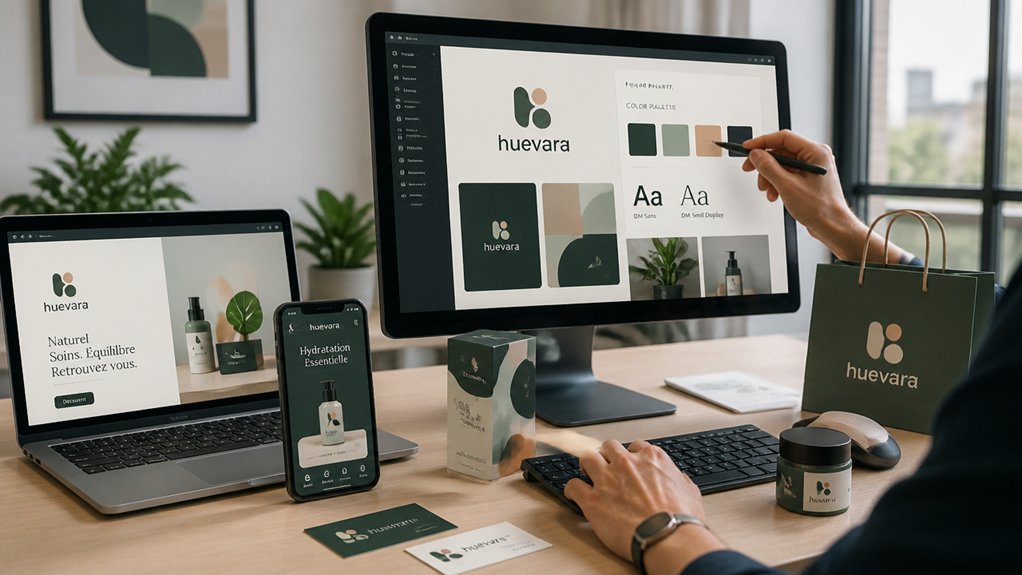
Although your brand may start with a logo and a tagline, online branding is the full system of signals that shapes how people perceive you across every digital touchpoint. You define brand identity through what you publish, how you sound, and the experience you deliver, not just what you claim.
It includes your website structure, UX writing, social bios, content themes, photography style, typography choices, and microinteractions like error messages and confirmations. It also covers trust cues—reviews, case studies, security signals, response speed, and accessibility—because these shape credibility and expectation.
When you maintain visual consistency, you reduce cognitive friction, improve recognition, and make decisions feel safer. Treat online branding as measurable: track recall, conversion lift, sentiment, and repeat visits over time.
Build a Consistent Online Brand & Digital Presence Across Channels
Because your audience meets you in different contexts—search results, social feeds, email, and your site—you need a brand system that stays recognizable without feeling copy-pasted. Start by defining non-negotiables: logo usage, color palette, typography, imagery style, icon set, and layout rules. Apply them everywhere so visual consistency reduces cognitive load and builds recall at a glance.
Then map each channel to a specific job: discovery, nurture, conversion, support. Keep offers, landing pages, and social profiles aligned with the same value proposition and proof points, even when formats change. Use repeatable templates for posts, emails, and pages to speed production while protecting standards.
Finally, connect touchpoints through brand storytelling that carries the same narrative arc from first impression to follow-up, so every interaction feels part of one experience.
Create a Clear Brand Voice for Web and Social
When you sound different on every platform, you force people to re-learn who you’re each time they see you.
Define a single voice that matches your Brand personality: choose 3–5 traits (direct, curious, optimistic) and pair each with do’s and don’ts for wording, punctuation, and humor.
Then translate that voice into repeatable patterns: headline formulas, post openings, CTA verbs, and reply templates for comments and DMs.
Keep your website more structured and your social more conversational, but don’t change your point of view or vocabulary.
Use Visual storytelling to reinforce the same tone—caption rhythm, color cues, and image choice should support the words, not fight them.
Review top posts quarterly and tighten anything that drifts off-brand.
How Does Online Branding Build Trust Before Clicks?

Before anyone clicks, your online branding signals whether you’re credible, consistent, and worth attention. People scan visuals, tone, and social proof in seconds, and they judge risk fast.
When your colors, typography, and messaging align across channels, you reduce uncertainty and strengthen Customer perception. Clear positioning answers “Who are you for?” and “What do you deliver?” without demanding extra effort from the viewer.
You build pre-click trust by showing coherence: a recognizable logo, consistent voice, and a website that loads cleanly and reads easily. You also earn confidence through transparent policies, real testimonials, and professional bios that match your content.
As Brand recognition grows, familiarity lowers friction, so prospects feel safer choosing you over lookalikes. That’s trust, built before action.
How to Measure Online Branding Impact (Metrics That Matter)
Pre-click trust only matters if it changes what people do next, so you need metrics that connect brand perception to real outcomes. Start with brand awareness signals: direct traffic share, branded search volume, and share of voice in your category.
Then validate quality with engagement metrics that show intent, not vanity: return visitor rate, time to first interaction, scroll depth, saves, and email sign-ups.
Next, tie brand lift to conversion efficiency. Track CTR from branded queries, landing-page conversion rate by source, and cost per acquisition trends as awareness grows. Use cohort analysis to see whether first-time visitors convert faster after repeated exposures.
Add sentiment and review velocity to capture trust shifts. Finally, attribute cautiously: compare brand campaigns against holdouts and monitor assisted conversions, so you don’t over-credit last-click wins.
Frequently Asked Questions
How Much Should a Small Business Budget for Online Branding?
You should budget about 5–10% of revenue for online branding, or $1,000–$10,000 upfront if you’re early-stage.
Put most into visual identity (logo, colors, typography, templates) and clear guidelines that protect Brand consistency across website, social, and email.
Add $200–$1,500 monthly for design updates, content support, and testing.
If you’re rebranding or scaling fast, plan higher to avoid costly fixes.
When Should We Hire an Agency Versus Building Branding In-House?
Hire an agency when you need fast, senior expertise to define brand strategy and visual identity, or when your team lacks time and cross-channel skills.
Build in-house when you can commit consistent resources, iterate weekly, and you’ve got clear decision-making and a strong internal brand steward.
Choose an agency for launches, repositioning, or complex competitive markets; choose in-house for steady optimization, content cadence, and cost control over time.
What Legal Steps Protect Our Brand Name, Logo, and Online Assets?
You protect your brand by filing Trademark registration for your name and logo, then documenting ownership of related Intellectual property. You should run clearance searches, register key domains and social handles, and lock down DNS, hosting, and admin access with MFA.
You’ll want written IP assignments from employees/contractors, plus licensing terms for partners.
You should monitor infringements, use takedown procedures, and keep consistent brand usage guidelines to defend rights.
How Do We Rebrand Without Losing Search Rankings and Existing Followers?
You rebrand without losing rankings and followers by migrating in phases: keep key URLs, set 301 redirects, update sitemaps, and preserve on-page keywords while revitalizing design.
Maintain Brand consistency across names, visuals, and messaging so search signals and recognition don’t break.
Protect audience engagement by explaining what’s changing, pinning updates, and inviting feedback.
Monitor Search Console, rankings, and churn weekly, then adjust content and redirects quickly.
Keep legacy assets accessible.
Which Branding Tools Best Streamline Design, Approvals, and Asset Management?
You’ll streamline design, approvals, and asset management with Figma for collaborative creation, Canva for fast production, and Frontify or Bynder for DAM and governance.
Use Brandfolder if you need simpler asset control. Pair these with Slack or Asana plus Zapier automations to speed reviews and reduce version chaos.
These tools protect brand consistency by centralizing templates, logos, and rules, so your visual identity stays consistent across teams and channels.
Conclusion
You don’t build a strong digital presence by showing up everywhere; you build it by showing up the same way. When your visuals align, your voice stays steady, and your promises match your proof, people trust you before they click. You’re not just posting, you’re positioning; not just designing, you’re deciding; not just measuring, you’re learning. Track recall, search lift, engagement quality, and conversion paths, and you’ll see branding compound across every channel.
About the Author